
 + 86 18721624519

Itutu inu agọ Telecom ita gbangba: Bii o ṣe le yan laarin awọn afẹ́fẹ́ ti a fi àlẹ̀mọ́, awọn paṣipaarọ ooru ati awọn amuletutu afẹfẹ
Three numbers decide which cooling route belongs on a telecom cabinet: the highest outdoor air temperature the site will actually see, the temperature limits of the equipment inside, and how clean that outdoor air is. Run them in order and each route either survives or drops out. Filtered ventilation, air-to-air heat exchange and refrigeration are not three options of equal merit; they are three stages of one exclusion path, and a site that fails the first stage cannot be rescued by a bigger fan.
Two of those numbers are commonly collapsed into one. The rectifier modules and the battery modules rarely share a temperature limit, and the acceptable range for radio equipment is not a substitute for the battery maker's charge, discharge and storage limits. Treat them as two separate questions and the cabinet may need two answers: one compartment on filtered air and a battery bay on something else, which is what dual-compartment cabinets are built for.
Write down the site numbers before comparing products
The table below is the input side of the decision, not a shopping list. Fill in each row from the site survey rather than from a catalogue, because a cabinet rating is only meaningful against a condition.
| Input | Kini lati gbasilẹ | Kí ló dé tí ó fi yí ìdáhùn padà |
|---|---|---|
| Highest outdoor air temperature | Design dry-bulb at the cabinet face, at the hottest hour, including solar gain on the wall it stands against | Sets the floor of every air-cooled route; ventilation and exchange cannot go below it |
| Rectifier air-intake limit | The module maker's maximum inlet temperature at full load | Decides whether ventilation survives the first stage |
| Battery module limits | Charge, discharge and storage limits from the battery specification, recorded separately | Usually narrower than the rectifier window |
| Afẹfẹ mimọ | Dust class or observed sedimentation, salt-fog exposure, corrosive gases, nearby construction or unpaved roads | Rules out direct outside-air ventilation when dust or salt would enter the equipment bay |
| Maintainable cleaning interval | Realistic site-visit frequency and who performs the visit | Filters and exchanger cores degrade between visits; the interval bounds the design, not the fan curve |
| Cooling supply during outages | Whether cooling is fed from the DC plant or only from AC | Determines whether the battery carries the load or the load plus the cooler |
| Cold-start conditions | Lowest ambient and whether heating is present | Decides whether a heater and humidity control belong in the same specification |
Standards help you describe the site in terms an equipment maker already uses. ETSI EN 300 019-1-3 classifies weatherprotected locations: class 3.3, neither temperature- nor humidity-controlled but partly weatherprotected, assumes a normal high air temperature of +55 °C and a normal low of −25 °C; class 3.2, partly temperature-controlled, sits at +45 °C and −5 °C; class 3.1, a temperature-controlled enclosed location, sits at +40 °C and +5 °C. Under ETSI EN 300 019-1-4 for non-weatherprotected locations, class 4.1 spans −33 °C to +40 °C, class 4.1E −45 °C to +45 °C, and class 4.2H −20 °C to +55 °C, with condensation, precipitation and coastal salt mist all expected. These are published severities with a low probability of being exceeded; they describe an environment, not a product's own rating. Use the closest class to label the site, then check whether your hottest days sit inside it. A site that routinely exceeds its class is not a class problem; it is a thermal design problem.
Stage 1: filtered ventilation, only if the outside air is already cool and clean
Ventilation is the cheapest cooling option and the only one that can remove heat at outside-air temperature, which is also its limit. It works when two conditions hold at once: the outdoor air never rises above what the protected equipment can accept, and the air carries nothing that would choke a filter or the equipment inside.
If both conditions hold, the next question is not how many fans fit on the door. It is how much air actually passes through the filter and the loaded cabinet. A fan's free-air figure is a bench measurement with nothing in front of it. Inside a cabinet, equipment, cable bundles, inlet and outlet grilles, the filter itself and any fan guard all add pressure drop, so the delivered volume is lower than the fan's datum and the internal temperature rise is proportionally higher.
The volumetric flow needed inside a cabinet follows from one relation: flow equals heat, divided by air volumetric heat capacity, divided by the permissible temperature rise. With dry air at roughly 1,200 J/m³·K, a 10 K window between the incoming air and the limit requires about 2,240 m³/h of internal air per kilowatt of dissipation. Take a 2.5 kW site with a 30 °C design ambient and a 40 °C rectifier intake limit: about 5,600 m³/h has to pass through the loaded cabinet to sit at that limit, and fan heat, solar gain on the enclosure and filter loading all push the internal air above it. The arithmetic is a selection check against the free-air figure, not a prediction of the site.
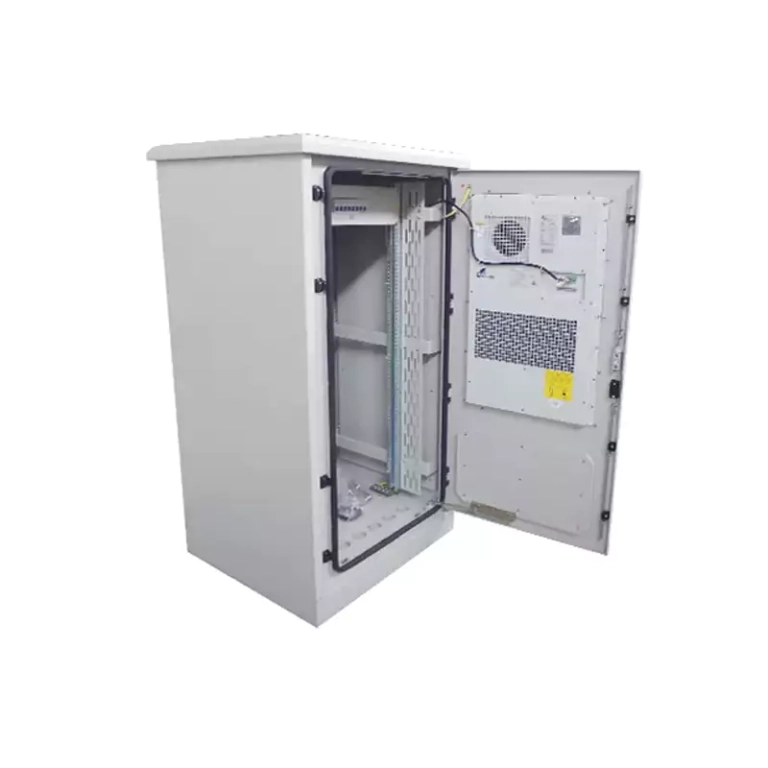
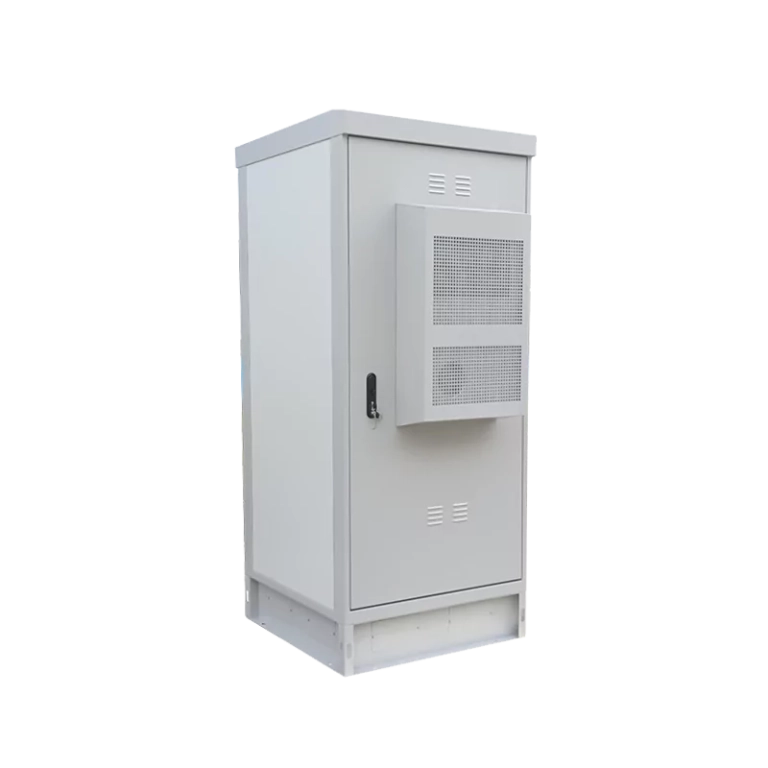
The 10-14U single-layer and double-layer fan-cooled cabinets (model families HJ-OWVS and HJ-OWVD) use an AC fan of 120 × 120 × 38 mm, rated 90 CFM (about 153 m³/h) at 19 W, and that figure applies to this series only. It is a fan specification, free-air and at nominal supply; it is not what the assembled cabinet delivers through its filter, and it is not a statement about how much heat the cabinet can reject. The arithmetic above is why small wall and pole cabinets suit modest dissipations in mild, clean conditions rather than a heavily loaded site in a hot region.
Undersizing is only half the trap. Airflow gains also flatten. In a peer-reviewed characterisation of an outdoor telecommunications cabinet, Silva and colleagues (2017) found that quadrupling airflow from 25 to 100 m³/h moved the internal temperature by only 3–5 K, and that between 75 and 100 m³/h the further gain was about 2 per cent of the temperature. The same paper reports that, in that cabinet, internal air stayed below 55 °C without forced ventilation only at dissipated power below about 100 W. Past that point the fan consumes power, adds a little of its own heat, and the useful range stays closed from above by the ambient.
Cleanliness is the other closing condition, and it fails slowly rather than loudly. Dust entering the cabinet accumulates on the filter and in the equipment bay, and salt-bearing coastal air attacks both the electronics and the internal fixings. The same study notes that filters are not built to keep their function for the life of the cabinet, so filter replacement is a recurring operating cost, and maintenance lapses reduce the effective airflow further. Before accepting ventilation, set the cleaning interval against the dust loading you expect and confirm the visit is realistic at that site. If the interval cannot be met or the air is saline, ventilation is finished regardless of what you spend on fans.
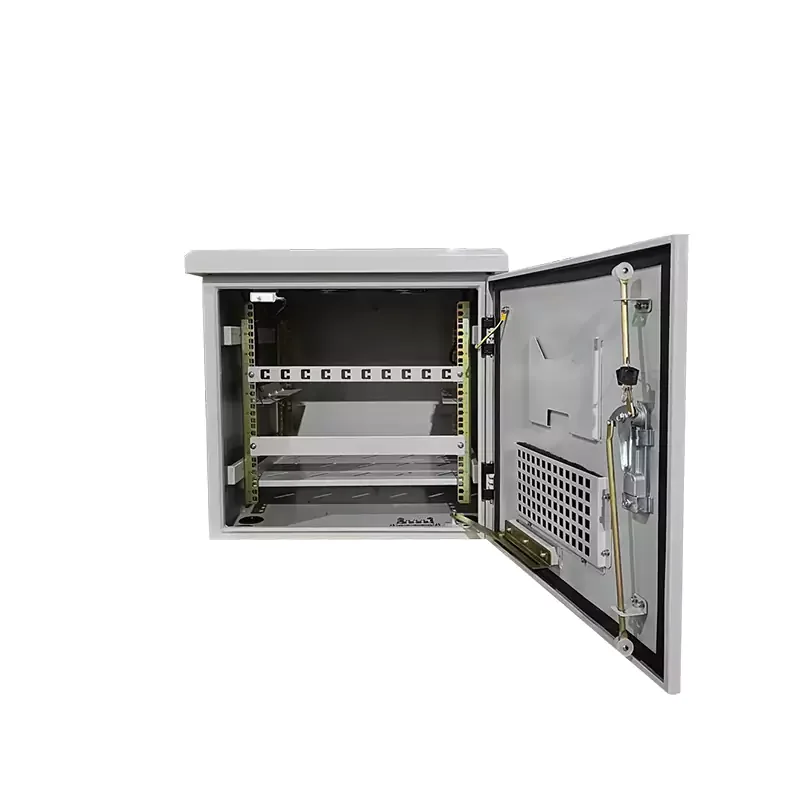
One more check on fan-cooled cabinets: their power rating is small but real, and it sits inside the thermal budget. Each 19 W fan adds about 19 W to the heat the cabinet has to remove, so a fan set sized on free-air airflow is partly cooling itself.
Stage 2: air-to-air heat exchange, when outside air would carry dust or salt inside
Once the cleanliness condition fails, direct outside-air ventilation is off the table. An air-to-air heat exchanger keeps the two air paths apart: outdoor air cools the external face of a core, internal air circulates through the other side, and the equipment bay never sees site air. It gives up the one advantage ventilation had in exchange for sealing the enclosure, and it still needs a temperature difference, so it inherits the same upper bound.
The published rating on an exchanger is usually not a fixed cooling output but a performance figure that depends on how far apart the two streams are. A figure stated as watts alone usually means watts at one tested condition, and it says nothing about a hotter afternoon. Ask for the unit's heat-transfer performance and either compute or demand the capacity at your own internal and external temperatures. With the air heat capacity used above, a 12 K approach between internal and external air and a 2.5 kW requirement need about 4,480 m³/h of internal air through the core. Halve the approach to the 6 K you might see on a hot afternoon and the flow requirement doubles, which is why exchanger size grows quickly in hot climates.
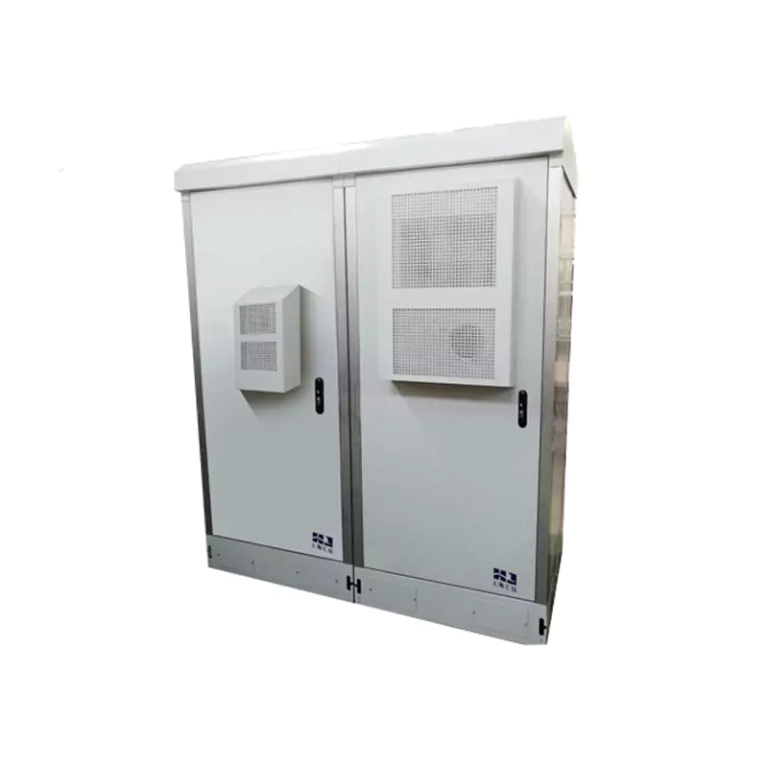
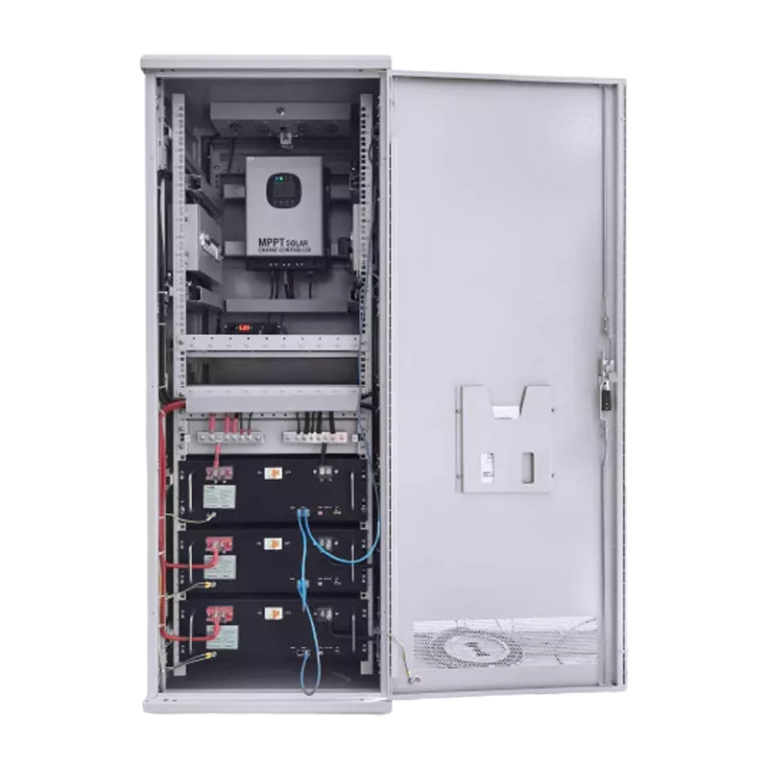
The Huijue heat-exchange outdoor cabinet HJ-XDF-JF41 is a dual-compartment, double-wall cabinet with a separate heat exchanger rated 80 W for the equipment compartment, in AC or DC, and two medium fans serving the battery compartment. That 80 W is the equipment rating, and its test condition is not stated on the published page, so read it as a class of unit rather than a guaranteed capacity in a 45 °C ambient. The dual-compartment layout is the more important design fact: the equipment and the battery can be held at different conditions, and the battery compartment is cooled by its own fans.
The second condition that decides whether an exchanger works is maintenance access, and the external face is the one that matters. The outdoor side of the core collects dust, insects, leaves and salt over the seasons. Once its fins are fouled, the approach temperature widens and the internal temperature rises at the same load. The exchanger's cleaning interval therefore has to be at least as achievable as the filter interval it replaced, and the cabinet has to be sited so that face can be reached.
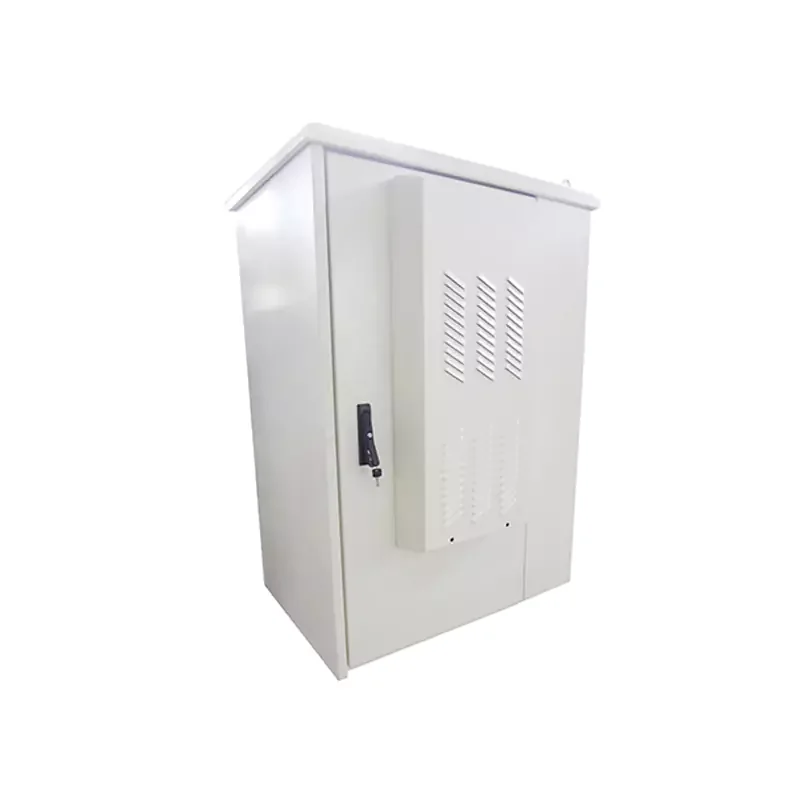
Heat exchange is the natural middle rung for a cool, dusty or coastal region where the ambient stays within a few kelvin of the target, and it is cheaper than refrigeration for a modest load. It is not a substitute for refrigeration, because no core can deliver an internal temperature below the incoming external air.
Stage 3: refrigeration, when the outdoor air is already warmer than the allowed internal temperature
When the design ambient is above the temperature the equipment is allowed to see, no amount of ventilation or exchange can help, because both routes stop at the outdoor air. That is the moment a compressor belongs in the specification, and it is defined by the protected limits, not by an industry default. A cabinet holding only rectifiers with a broad inlet allowance may never need one; a cabinet holding batteries with a narrow window may need it on a site where the rectifiers would have been fine on ventilation.
The refrigeration decision is mostly about which capacity figure you accept. Manufacturers quote cooling capacity at a reference condition, usually not the worst one on site. On a 45 °C day a compressor's delivered capacity falls while its input power rises, so the figure that decides the specification is capacity at the site's design ambient. The same study puts the electrical cost in perspective: refrigeration can account for roughly 30–50 per cent of a base station's total energy use. Ask for capacity and power draw at the reference condition and at your design temperature, and make both part of the comparison.
Three installation facts go with the compressor. Condensate has to drain somewhere sensible, not into the cabinet or across a walkway. The condenser has to reject heat into air that can take it, which rules out an alcove with no cross-flow. And the outdoor coil needs access for cleaning, because a fouled condenser is a capacity loss as well as a service event.
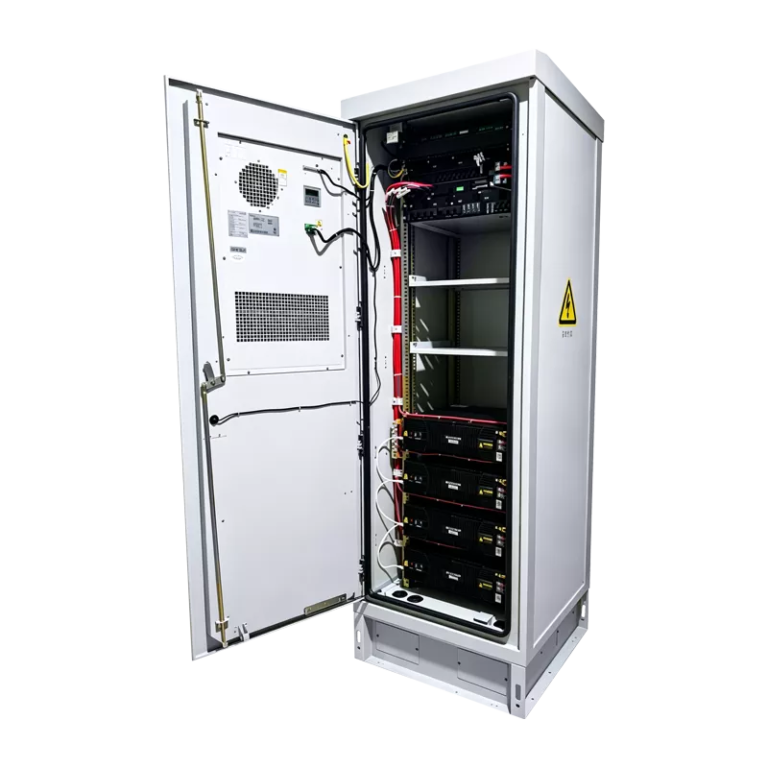
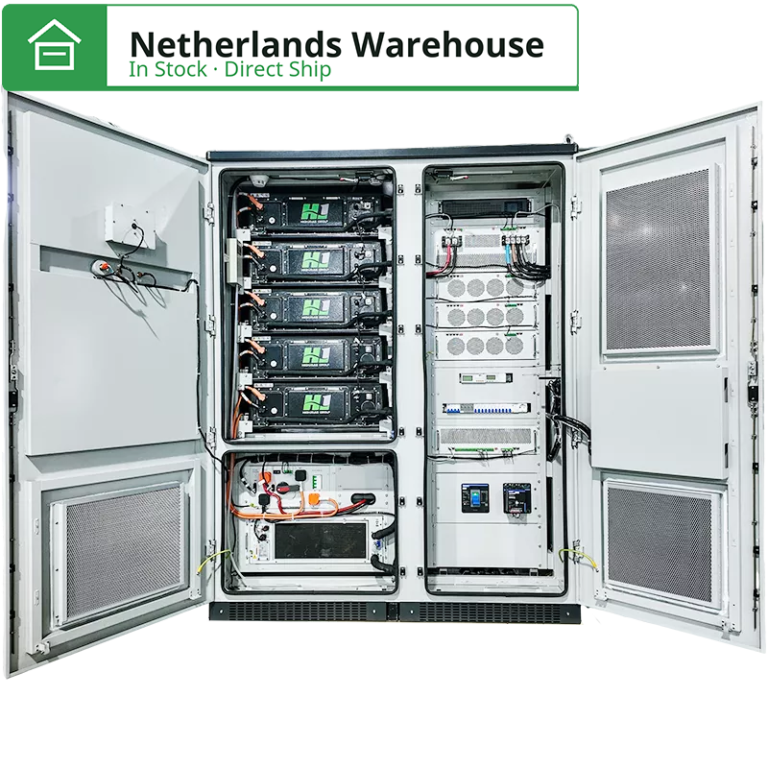
In our own range the cooling unit follows the cabinet format rather than the other way round. The Outdoor Air-Conditioned Cabinet HJ-XDF-JF21 is a 15U sheet-metal cabinet with a 300 W compressor unit inside a double-wall, 20 mm EPS insulated enclosure; the 32U HJ-XDF-JF25 is a dual-compartment cabinet with two 1000 W compressor units and a battery rack, available on AC or DC; the sandwich-panel Outdoor Weatherproof Thermostatic Cabinet HJ-XDF-X03 runs a 1500 W compressor unit per cabinet with an optional second unit of 300–3000 W. Each of those figures is a published unit rating without a stated ambient, so the same rule applies to us: confirm capacity at your design temperature. Which format fits also depends on load and layout, which we size per site.
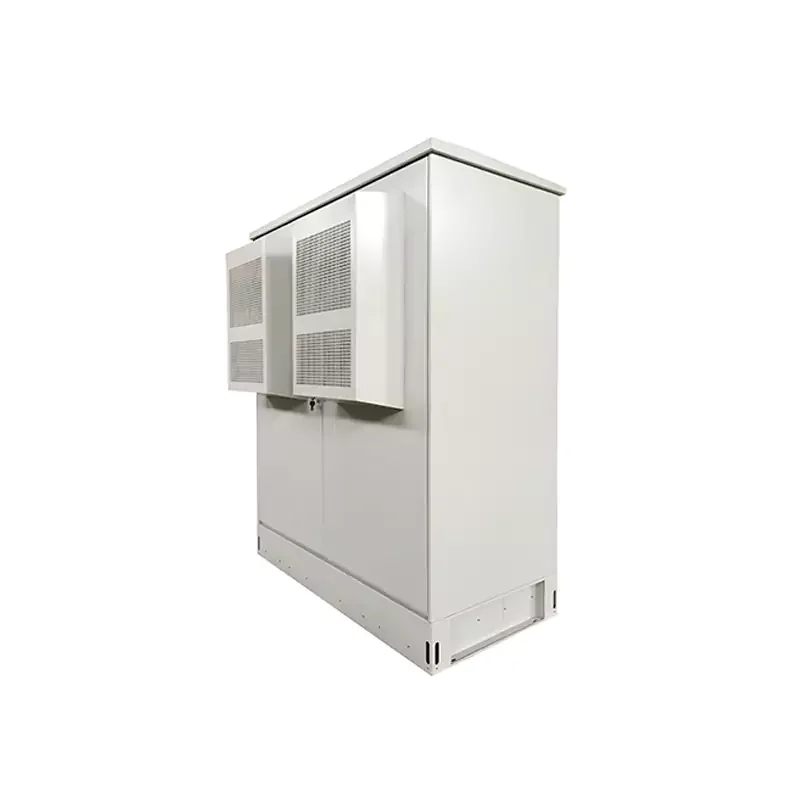
A partly open arrangement is not a compromise. When a cabinet has an air conditioner carrying the peak and ventilation for the rest of the year, the two routes work together and the compressor runs fewer hours. What that needs is control logic, not a fourth cooling technology: whichever route is active must protect the narrower temperature limit inside.
Stage 4: cooling has to survive the battery, or the site fails on a cool day
The thermal decision is not finished when the cooling unit is chosen, because the cabinet is most likely to lose its mains supply on the same day the cooling is most needed. If the cooling unit runs on mains AC and the site falls to battery, the air conditioner stops while the equipment keeps working. The battery then carries the load in a sealed cabinet whose internal temperature rises with every hour of runtime. That outcome is a design decision, and it belongs to the backup calculation rather than to a troubleshooting note for later.
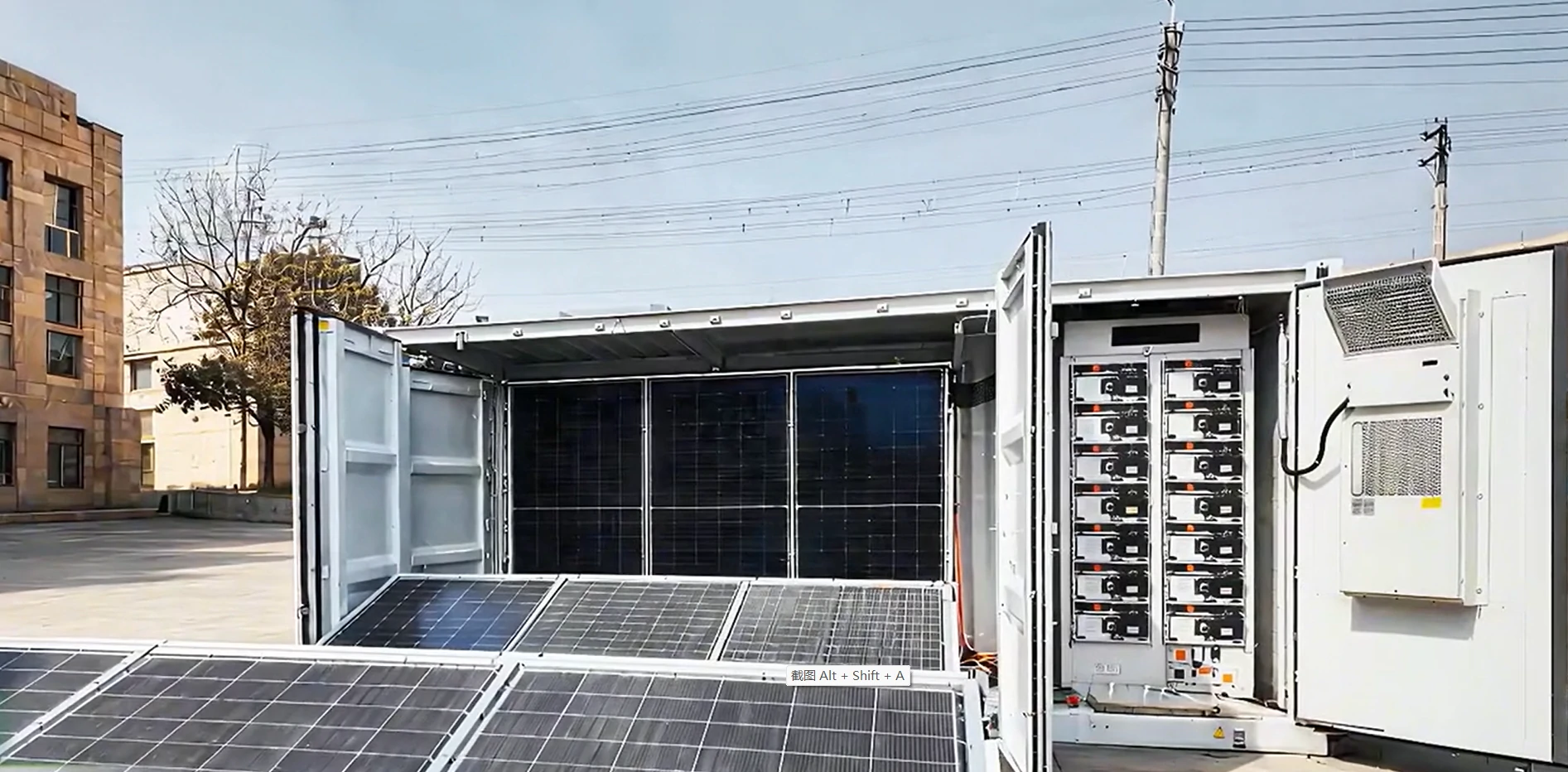
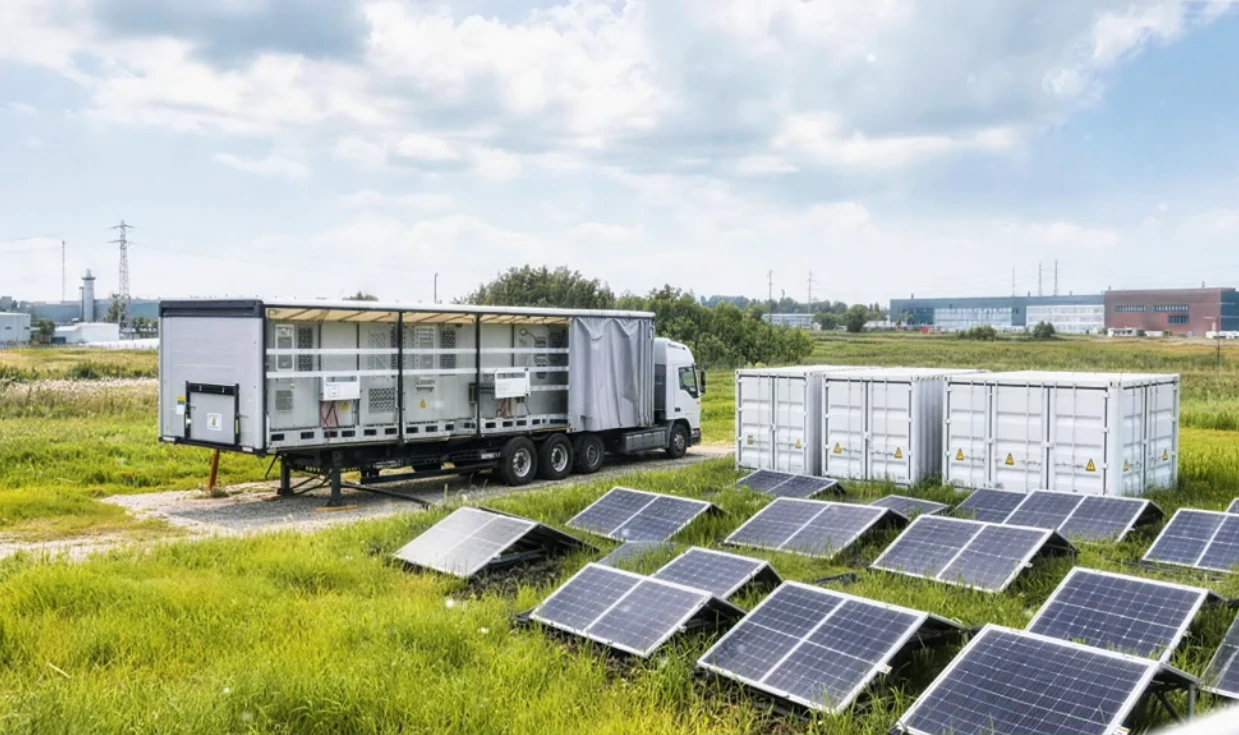
Three arrangements meet in the same arithmetic. First, put cooling on DC so it can draw from the same plant as the load; the Kenya off-grid project shows that route, with a 200 kWh outdoor base-station energy cabinet and a DC 48V compressor-type air conditioner with RS485 communication, built for high-temperature outdoor sites. Second, accept interruption for a known period, which means calculating how the cabinet's internal temperature behaves over that period at the battery's own discharge window and at the outdoor air temperature likely to coincide with an outage. Third, add a fan for ventilation only, which raises the airflow ceiling but does not defeat a hot ambient. The Outdoor Weatherproof Thermostatic Cabinet HJ-XDF-X03 takes the third route, with an emergency fan that starts when the air conditioner loses power; useful, and still bounded by the outdoor air.
The arithmetic uses the same relation as stage one, with time on one side. The rate at which the cabinet heats with cooling off depends on stored heat and on the heat capacity of steel, insulation and equipment, and it stays approximate until the site is modelled. What matters for the decision is the pairing: if the acceptable interruption is shorter than the time the cabinet takes to reach the protected limit, cooling has to be on the DC plant, or the specification has to name a dual-power supply for the cooler. If the plant is sized for the load alone and the cooling draws from it too, the runtime quoted for the load is not the runtime the site will get.
Where mains supply is intermittent and solar is the main source, this is not an edge case. The Kenya off-grid base-station project runs an outdoor energy cabinet and a DC compressor air conditioner together, which is consistent with cooling and load sharing one DC supply.
Stage 5: cold start and condensation belong in the same specification
The specification usually gets written in summer and installed in a shoulder season. A cabinet that was correctly cooled for the hot case can still fail on the first cold night, and a cabinet that was correctly cooled in a dry climate can corrode in a humid one. Heating and humidity control are part of the thermal answer, not an optional accessory added after it.
The class references describe the conditions that matter. ETSI EN 300 019-1-3 classes 3.3 and 3.4 both assume condensation and icing, and class 3.3 also assumes limited wind-driven precipitation. The non-weatherprotected classes under EN 300 019-1-4 assume condensation, precipitation and splashing water. Condensation on a cold start is a real possibility wherever the site meets any of those classes, and it often reaches the internal electronics through the same route the cooling equipment uses: a fan intake brings humid air in directly, and a heat exchanger's core is open to outdoor air.
Heating does two jobs in cold climates. It keeps the electronics above their minimum temperature, and it lowers relative humidity at a given vapour content, which reduces condensation. Specify heating and humidity control together with cooling by asking for the cabinet's full thermal envelope, including heater wattage and thermostat. If cooling goes out to tender separately from heating, the result is a cabinet sized for July with nothing planned for February.
For a cabinet that holds a battery, the point is sharper. The narrower of the two temperature windows usually belongs to the battery, and it is the one the operator is least able to observe from an office. When battery and electronics share a compartment, the tighter limit governs the whole thermal design, which is why dual-compartment and sandwich-panel formats carry real selection weight rather than being cosmetic choices.
Comparing the three routes to a quote
Set the routes side by side with their conditions attached and the choice becomes explicit. The table summarises what to ask for; it is not a price comparison.
| Ipa ọna | Survives when | What to confirm in the quote | Kùnà nígbà tí |
|---|---|---|---|
| Afẹ́fẹ́ tí a yọ́ | Outdoor air stays below the protected limits; dust and salt loading are low | Delivered airflow through filter and loaded cabinet; fan power inside the thermal budget; filter replacement interval | Ambient exceeds the limit, or cleaning cannot keep up |
| Pípàṣípààrọ̀ ooru afẹ́fẹ́ sí afẹ́fẹ́ | Outdoor air stays below the target; internal and external air must be separated | Capacity at the site's temperature difference; external core cleaning access and interval | Ambient rises to or above the target |
| refrigeration | Equipment must be held below the ambient | Capacity and input power at design temperature; condensate route; condenser air and cleaning space; DC or dual power for outages | Backup runtime cannot cover the cooler, or heat rejection is blocked |
One pair of rows often appears on the same site. A dual-compartment cabinet can run cooling on the equipment side and ventilation or a separate fan set on the battery side, or hold both sides under a single air conditioner when the load justifies it. Dual compartment is a way of avoiding the tighter limit at the cost of a bigger cabinet, not a promise that one cooler suits both.
Kini lati fi ranṣẹ pẹlu ibeere kan
The fastest route to a usable answer is a site sheet rather than a request for a price list. Include the design outdoor air temperature at the cabinet face and its solar exposure; the equipment list with each item's dissipation; the rectifier intake limit; the battery module's charge, discharge and storage limits; the dust, salt and humidity conditions; the realistic cleaning interval; the power arrangement, including whether the plant is DC, PV, grid or generator, and the expected runtime during an outage; and the cold-start conditions. With those, the choice among ventilation, exchange and refrigeration, and the power design for the cooling, follow directly.
Two further details belong in the request because they decide maintenance and lifetime: how accessible the outdoor face of a heat exchanger or condenser will be, and who will service it. A cooling unit earns its place through capacity at your design temperature and cleanliness at your cleaning interval, not through its model name.
Àtúnṣe ìkẹyìn ní 2026-11-26